Growth Hormone Signaling Axis Explained
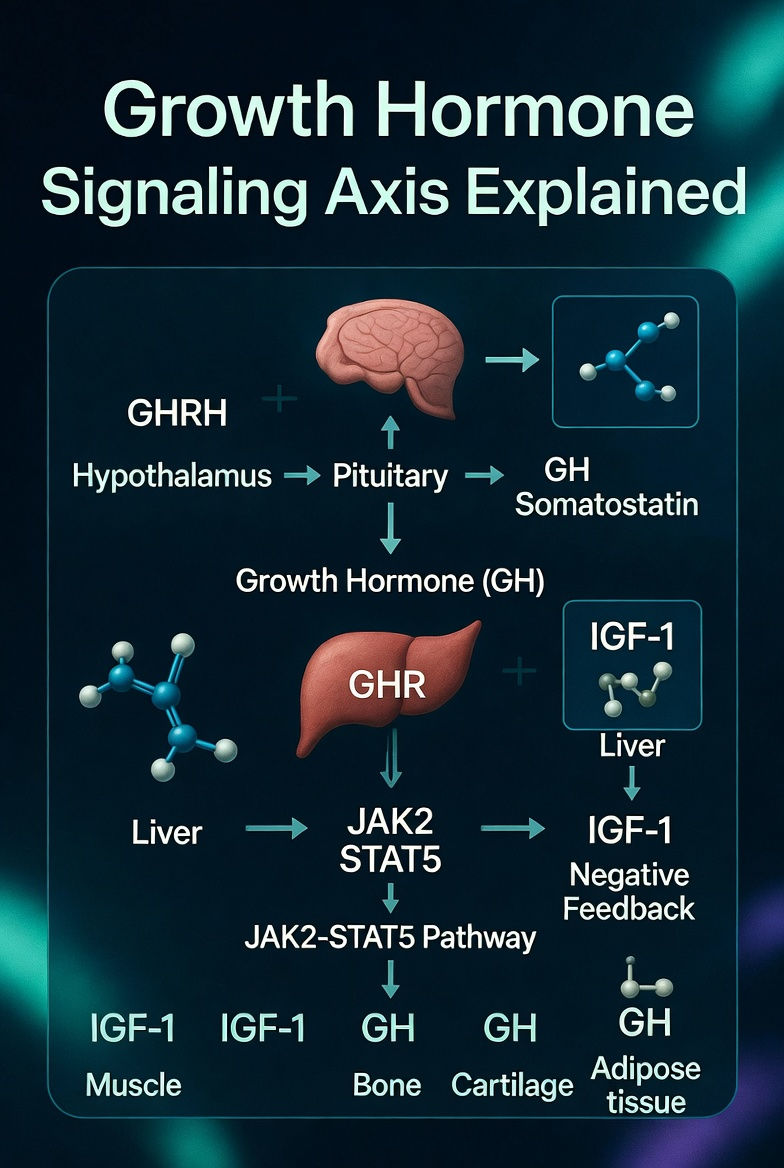
The growth hormone (GH) signaling axis is one of the most critical regulatory systems in human biology, governing processes such as tissue repair, metabolic balance, cellular regeneration, and long-term adaptation. In Targeted Peptide Systems, this axis is not viewed as a simple hormone pathway but as a multi-layered signaling hierarchy that must be respected rather than overridden.
At its core, the GH axis consists of three primary levels:
Hypothalamus (signal initiation)
Pituitary gland (signal amplification)
Peripheral tissues (signal execution)
The hypothalamus releases growth hormone–releasing hormone (GHRH) and somatostatin, which respectively stimulate and inhibit GH release. This creates a dynamic push-pull system that regulates pulsatile hormone output.
The pituitary gland responds to these signals by releasing growth hormone in pulses rather than continuously. This pulsatility is essential. Continuous GH exposure leads to receptor desensitization and reduced biological responsiveness.
Once released, GH acts directly and indirectly on peripheral tissues through insulin-like growth factor 1 (IGF-1), which mediates many downstream effects related to growth and repair.
Within Targeted Peptide Systems, peptides that interact with the GH axis are categorized as modulators of natural signaling rather than replacements. They function by influencing the upstream regulatory mechanisms rather than bypassing them.
For example, certain peptides stimulate GHRH pathways, while others reduce inhibitory signals like somatostatin. This creates a more physiological pattern of GH release, preserving the system's natural rhythm.
This distinction is critical. When the GH axis is stimulated in alignment with its natural pulsatile pattern, the body remains responsive. When it is overridden or continuously stimulated, adaptation occurs rapidly.
The GH axis also interacts with multiple other systems:
Metabolic pathways (glucose regulation, lipid metabolism)
Sleep cycles (deep sleep is a major driver of GH release)
Stress response systems (cortisol can suppress GH output)
Nutrient availability (amino acids influence signaling capacity)
This interconnectedness reinforces a central principle of the book:
You cannot isolate a signaling pathway without affecting the system it belongs to.
Another key concept is signal hierarchy. The GH axis sits upstream of many regenerative and metabolic processes. If this axis is dysregulated, downstream interventions become less effective.
For example, attempting to enhance tissue repair without addressing GH signaling often yields incomplete outcomes because the upstream regulatory signal is insufficient.
In practical terms, effective modulation of the GH axis requires:
Respect for pulsatile signaling
Avoidance of continuous overstimulation
Alignment with circadian rhythms
Consideration of systemic stress and recovery
In Targeted Peptide Systems, the GH axis is treated as a central control node. Rather than forcing outcomes, the goal is to optimize the system’s ability to produce its own signals effectively.
Ultimately, the growth hormone axis is not just a pathway—it is a regulatory framework that coordinates multiple aspects of human physiology. Understanding and respecting its structure transforms peptide use from intervention into precision modulation of biological rhythm.


Comments