[ PEPTIDE_ID: RETATRUTIDE // TRIPLE_AGONIST ]
Retatrutide
(LY3437943)
Retatrutide is an experimental triple hormone receptor agonist for the GIP, GLP-1, and glucagon receptors. It is engineered for precision research focusing on profound metabolic signaling and advanced weight regulation protocols.
Molecular Formula
C221H342N62O68
Status
[ PHASE_III_RESEARCH ]
Retatrutide
Retatrutide is often described as the “next generation” of metabolic peptides, but that phrase does not fully explain what makes it different. In the Targeted Peptide Systems framework, Retatrutide is best understood as a multi-axis metabolic governance peptide—a compound designed not to push only one satiety lever or one glucose-control pathway, but to influence the broader decision-making architecture of energy balance itself.
That distinction matters because obesity and metabolic dysfunction are rarely the result of one broken pathway. They emerge when satiety signaling, glucose handling, energy expenditure, nutrient partitioning, hepatic metabolism, and reward biology begin drifting out of alignment at the same time. The body may remain biologically “fed,” yet continue behaving as though energy is scarce, storage is necessary, or satiety is incomplete. Retatrutide becomes especially important because it appears to intervene at multiple levels of that dysregulation simultaneously.
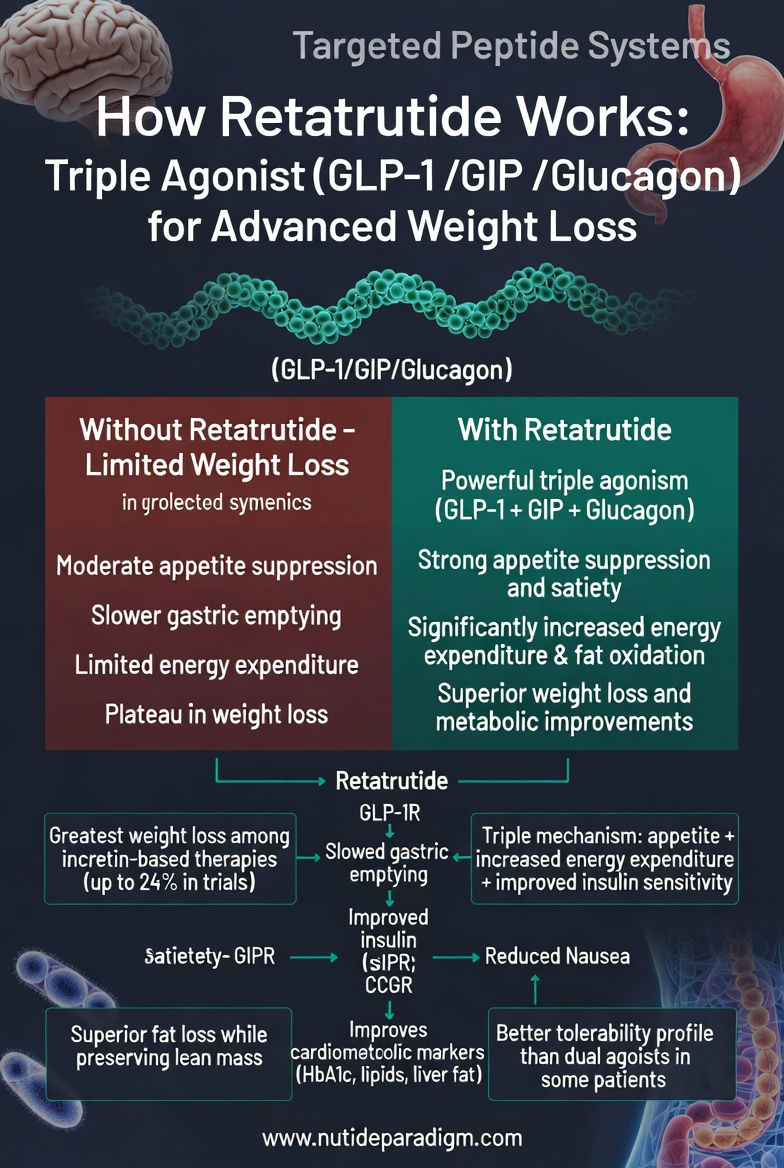
Retatrutide is a triple agonist, meaning it activates the receptors for GLP-1 (glucagon-like peptide-1), GIP (glucose-dependent insulinotropic polypeptide), and glucagon. That combination is what makes it mechanistically distinct. GLP-1 contributes to satiety, slowed gastric emptying, reduced food intake, and glucose-dependent insulin support. GIP appears to modify nutrient handling and may improve the tolerability and metabolic coherence of incretin signaling in certain contexts. The glucagon component is what makes Retatrutide especially interesting from a systems standpoint, because glucagon receptor agonism adds a fuel-mobilization and energy-expenditure dimension that is not central to standard GLP-1 monotherapy.
That third arm—the glucagon receptor component—is where the science becomes more nuanced.
Glucagon is often simplistically framed as the “opposite of insulin,” but in systems biology it is more accurately understood as a resource liberation hormone. It helps mobilize stored substrates and supports metabolic flexibility when energy needs shift. On its own, excessive glucagon signaling could create undesirable effects, particularly around glucose production. But when glucagon receptor activation is carefully paired with GLP-1 and GIP signaling, the biology changes. Instead of simply raising glucose, the combined system may produce a more elegant phenotype: less hunger, more satiety, improved insulin support, and greater access to stored energy. This is why Retatrutide is not merely a stronger appetite drug—it is conceptually closer to a metabolic reprogramming peptide.
Within the Targeted Peptide Systems framework, that places Retatrutide in a category beyond simple “weight-loss therapy.” It functions more like a whole-system energy allocation signal. Rather than acting only at the level of food intake, it appears to influence how the organism interprets sufficiency, handles substrate flow, and decides whether to remain in a storage-oriented state or transition toward mobilization and utilization.
This helps explain why Retatrutide has generated so much interest. In a phase 2 obesity trial published in the New England Journal of Medicine, adults with obesity or overweight experienced substantial weight reduction, with the highest efficacy arm showing mean weight loss of about 24.2% at 48 weeks. Importantly, this was not merely a small cosmetic shift. The trial also showed strong proportions of participants achieving clinically meaningful thresholds such as 10%, 15%, and 20%+ weight reduction, with gastrointestinal side effects being the most common dose-related limitation.
But the real scientific interest is not just the magnitude of the outcome. It is what the outcome implies.
Retatrutide suggests that body weight is not regulated by one satiety hormone or one behavioral correction. It appears to support the idea that meaningful metabolic change happens when the organism simultaneously receives signals that say:
-
You have enough incoming energy
-
You do not need to keep seeking food
-
You can mobilize stored substrate more confidently
-
You can improve glucose handling while doing so
That is a much more sophisticated biological message than appetite suppression alone.
There is also growing interest in how Retatrutide may influence hepatic fat, insulin resistance, and broader cardiometabolic risk, because a compound that improves metabolic traffic flow at multiple levels may produce benefits beyond scale weight alone. This is consistent with the larger thesis of Targeted Peptide Systems: the most meaningful peptides are often the ones that improve systemic coherence, not just visible symptoms.
At the same time, Retatrutide should not be mythologized. It is powerful, but it is not magical. A peptide can improve signaling architecture, but it does not create sleep discipline, resistance training, protein adequacy, or emotional stability around food out of nothing. It can dramatically improve biological permission, but long-term resilience still depends on whether the rest of the system is built to support the new metabolic state.
That is one of the most important truths Retatrutide reveals: obesity is often not a simple issue of excess intake. It is a problem of misgoverned biological instruction. The body is receiving the wrong internal messages about hunger, storage, and energy access. Retatrutide appears meaningful because it does not merely mute one of those messages—it may help rewrite several of them at once.
Within Targeted Peptide Systems, Retatrutide earns its place because it reflects a central principle of modern metabolic science: lasting body-composition change rarely comes from force. It comes from restoring a more intelligent conversation between appetite, storage, and energy demand.
Retatrutide matters because it appears to speak that language with unusual breadth.
Research Citation
Jastreboff AM, Kaplan LM, Frías JP, et al. Triple-Hormone-Receptor Agonist Retatrutide for Obesity — A Phase 2 Trial. New England Journal of Medicine. 2023.
Doggrell SA. Is retatrutide (LY3437943), a GLP-1, GIP, and glucagon receptor agonist a step forward in the treatment of diabetes and obesity? Expert Opinion on Investigational Drugs. 2023.
[ VISUAL_REF: MOLECULAR_MAPPING_V5.01 ]
[ CATALOG_REF: DATA_DOCK_v4 // SECTION: SCIENCE_02 ]
Scientific Backing

TECHNICAL_DOSSIER // PEPTIDE_SYNC
- ID: RET_LY3437943
- CLASS: Tri-Incretin Agonist
- AFFINITY: GIPR / GLP-1R / GCGR
- PURITY: 99.8% Research Standard
The scientific framework for Retatrutide operates through a precision-engineered signaling mechanism. By mimicking endogenous biological messengers, it facilitates high-affinity binding at specific receptor sites to initiate essential cellular repair and metabolic regulation pathways.
Mechanism Data Stream
01. TRIPLE_AGONISM_SYNC
Concurrent activation of GLP-1, GIP, and glucagon receptors initiates a potent metabolic cascade, optimizing energy expenditure and glucose homeostasis through regulated biological feedback.
02. METABOLIC_FLUX_OPTIMIZATION
The multi-receptor approach promotes significant weight reduction and metabolic health by modulating appetite signaling and adipose tissue metabolism simultaneously.
Applications & Biological Impact
[ MODULE_03 // SYSTEM_BENEFITS ]
Analysis of target receptor signaling and systemic efficacy protocols. Placeholding for peptide-specific validation data.
PROTOCOL_01
Primary Biological Objective
Placeholder description for the primary system benefit. Details regarding cellular interaction and targeted metabolic pathways will be defined in the final protocol sync.
PROTOCOL_03
Regenerative Capacity
Future data node for tissue-specific repair and longevity markers. This section will detail the specific regenerative pathways activated by modular signaling.
PROTOCOL_02
Systemic Enhancement
Detailed analysis of cross-system optimization. Placeholder text describing how the molecule impacts secondary biological networks and regenerative cycles.
PROTOCOL_04
Cognitive & Neural Resilience
Placeholding for neural pathway optimization data. Description of effect on neuroplasticity, focus modulation, and cognitive protection parameters.
[ MODULE_04 // USAGE_PROTOCOLS ]
Logistics & Handling Matrix
- RECONSTITUTION: Utilize 1.0mL Bacteriostatic Water per 10mg lyophilized Retatrutide vial for targeted concentration calibration.
- STORAGE PARAMETERS: Maintain structural integrity at -20°C for long-term preservation; strictly 2-8°C post-reconstitution for no more than 14 days.
- HANDLING PROTOCOL: Avoid mechanical agitation; gentle swirling for dissolution only to prevent molecular shearing of peptide chains.
- ENVIRONMENTAL SYNC: Protect from direct light exposure to ensure chemical stability during data mapping phases.
[ SYSTEM_ALERT: RESEARCH_ONLY ]
This molecule is strictly for laboratory research and in-vitro testing. Not for veterinary or human therapeutic use. Biological data mapping must be conducted within secure sector guidelines and established safety parameters.
[ ASSET_LIBRARY // SECTOR_12_RESOURCES ]
Related Molecular Documentation & Research
STATUS: DATABASE_SYNC_COMPLETE // SECTOR_12_SECURE